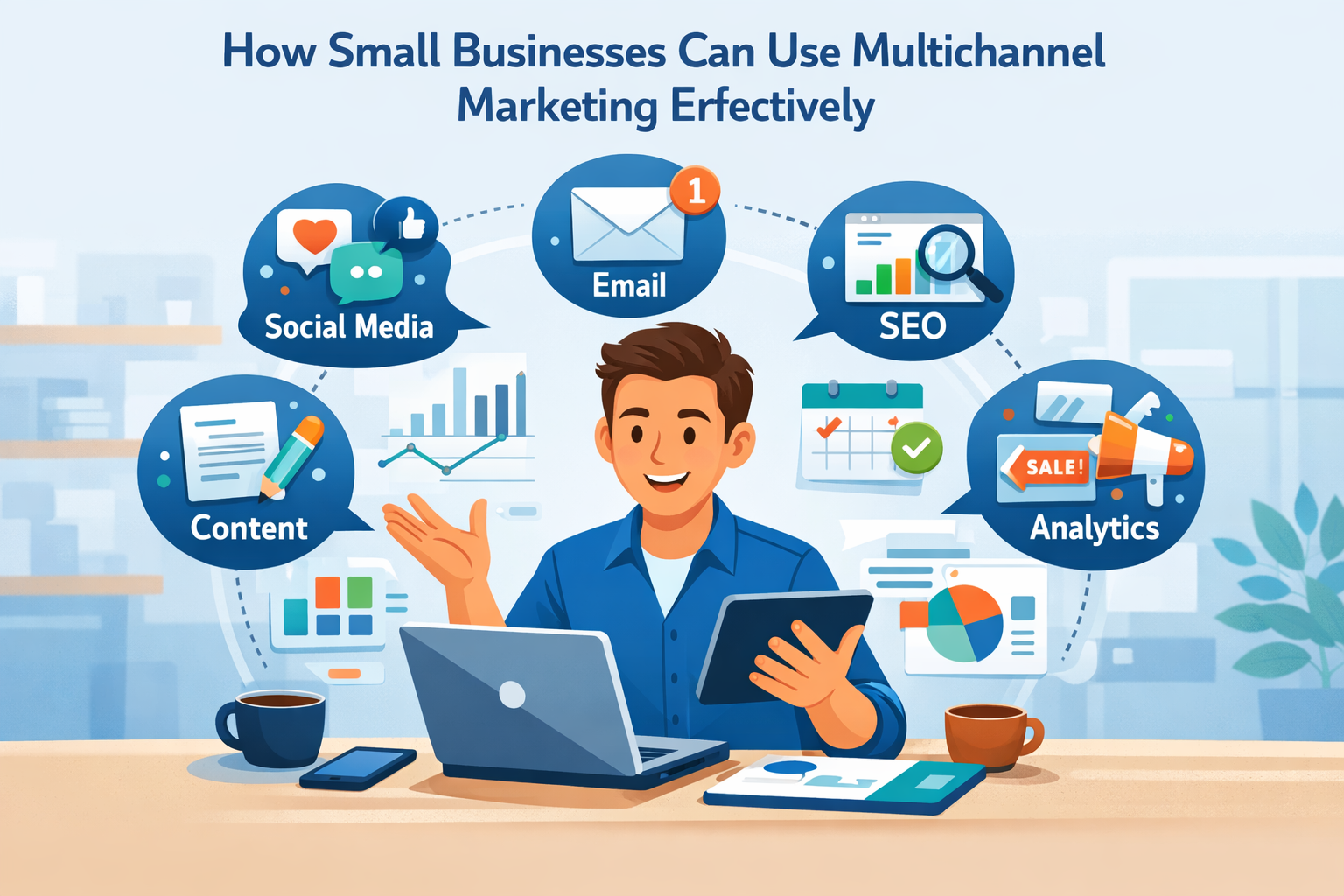
The Practical Playbook for Founders, Local Businesses & SME Teams
Running a small business today means competing for attention in a noisy world.
You’re not just selling your service.
You’re juggling:
- Content ideas
- Google rankings
- Social platforms
- Customer reviews
- WhatsApp responses
- Offline sales conversations
And somewhere in between, you’re expected to grow the business.
That’s why multichannel marketing matters more than ever —
because no single platform will deliver all your customers consistently.
This guide breaks down:
- What multichannel means
- How to choose the right channels
- How to execute with limited time
- Local SEO + AEO (Answer Engine Optimization)
- Simple tracking systems
- And how small teams win without burnout
Let’s dive in.
What Is Multichannel Marketing (Without the Buzzwords)?
Multichannel marketing means your business shows up across more than one platform — so customers can find you wherever they’re already spending time.
Think of visibility like storefronts.
A business active on:
- Google Search
- Google Maps
- Instagram
- WhatsApp
- A website
…has five storefronts instead of one.
Even if each delivers a few customers, the combined impact is much bigger.
Multichannel ≠ Being Everywhere
You don’t need:
× Twitter
× Snapchat
× Quora
× 11 social apps
You need 2–4 channels done well, not 10 done badly.
Why It Matters for Small Businesses
Customer journeys are not linear anymore.
A person discovers you when:
- Their friend shares your Reel
- They Google “salon near me”
- They scroll Map results
- They check website reviews
- They browse your menu or services
- They ask a question on WhatsApp
You might win them on the first touch —
but most buyers need 4–7 interactions before deciding.
Multichannel = more touchpoints
More touchpoints = more trust
More trust = more sales
Step 1 — Know Your Audience (and Your Geography)
Multichannel is pointless without direction.
Answer three questions clearly:
1️. Who are you selling to?
Examples:
- New moms buying from your boutique
- Small businesses needing tax help
- Students joining your coaching
- Neighbourhood families choosing a café
2️. Where do they hang out?
- Busy professionals scroll Instagram after work
- Homeowners search Google for plumbers
- Businesses research vendors on LinkedIn
- Local parents rely on Google Maps + WhatsApp groups
3️. Where do they buy?
Some buy online instantly.
Some walk into a store after researching.
Some call to confirm pricing.
Most browse silently for days.
When you match channels to behaviour, marketing becomes efficient instead of random.
Step 2 — Build Owned Assets First (The Foundations)
Platforms come and go.
Your owned assets stay.
Essentials small businesses must own:
Website or landing page
Google Business Profile
Google Maps listing
A WhatsApp or email list
Service, menu, or pricing clarity
Customer FAQs
If a channel died tomorrow (e.g., Instagram got shut down), you’d still have:
- Your ranking on Google
- Your customer database
- Your pages that convert
Owned assets compound.
Posts disappear.
Step 3 — Pick Your Channels Intentionally
Choose based on strengths, time, and audience.
Best channels for common business types
Local shops, cafés, salons
- Google Business Profile
- Instagram
- WhatsApp Broadcast
- Flyers & in-store QR
Home & service professionals (electricians, tutors, trainers)
- Google Business + Maps
- Local SEO landing pages
- WhatsApp for quotes
- FB & community groups
Consultants & B2B
- LinkedIn
- Website SEO
- Case-study style content
- Email nurture
Start with two channels you can show up on weekly.
Add more later when consistent.
Step 4 — Create Content That Travels Across Channels
Small teams don’t have time for original content everywhere.
Use the 1 big, 5 small method:
Create ONE long content piece weekly:
Examples:
- Blog
- 5-minute talking head video
- LinkedIn post thread
- Customer FAQ
Then repurpose into:
3–5 social posts
1 email or WhatsApp update
A short video or Reel
A Google Business update
A website FAQ update
One idea → multiple touchpoints → maximum reach with minimum time.
Bonus tips
- Talk like humans, not marketers
- Stories beat slogans
- Proof beats claims
- Consistency beats creativity
Step 5 — GEO Optimization (Show Up Near Buyers)
Local visibility beats global fame every day.
Small steps that move the needle:
Put your city, area, and neighbourhood into:
- Website headers
- Service pages
- Meta titles
- Google Business posts
Example:
“Best salon for hair spa”
“Best hair spa salon in Bangalore JP Nagar”
Join community spaces where locals gather:
- Local WhatsApp groups
- Facebook neighbourhood groups
- Resident forums and housing societies
Partner with businesses near you:
- Salons + gyms
- Cafes + coworking spaces
- Photographers + event planners
Local networks create referrals faster than ads.
Step 6 — AEO: Answer Engine Optimization
Search is evolving from keywords → questions.
People now ask:
- How do I choose a lawyer?
- Which fitness trainer is right for beginners?
- What is the cheapest way to file taxes?
AI search and Google increasingly pull answers from:
FAQs
Table of contents blogs
Clear service pages
Step-by-step guides
Do this today:
- Add FAQs to every webpage
- Turn customer questions into posts
- Write “How it works” guides
- Compare alternatives honestly
- Review your Google Q&A and reply with value
Businesses that teach win attention before they sell.
Step 7 — Measure and Iterate (The Simple Way)
No need for complicated dashboards.
Track three things weekly:
1️. Where did enquiries come from?
2️. Which channels drove the most conversations?
3️. Which channel produced actual customers?
If Instagram gave you attention but Google brought customers:
→ Shift effort
If WhatsApp queries close fastest:
→ Build automation + quick replies
Multichannel doesn’t mean everything forever —
it means testing multiple and scaling what works.
Multichannel for Teams With No Time
You win if you:
- Plan once weekly
- Batch content
- Repurpose aggressively
- Automate responses
- Leverage templates
- Stop overthinking perfection
Consistency beats brilliance.
Where Nexbuz Fits In
Most founders understand marketing —
they just don’t have the bandwidth to do it every week.
Nexbuz makes multichannel marketing simple by helping you:
Plan content and SEO
Publish across multiple channels
Optimise Google Business & Local SEO
Repurpose content for maximum reach
Track what’s working
Build a system that grows with you
We’re not a big agency.
We’re your done-with-you marketing partner.
(If you want me to remove or rewrite this line, say the word.)
Final Action Plan (Start Small, Scale Smart)
You don’t need 10 platforms, a big team, or a huge ad budget to grow.
Start with this 5-channel starter stack that consistently wins for small businesses:
1️. Google Business Profile → Weekly Posts + Reviews
Your most important storefront isn’t your shop or website —
it’s your Google Business listing.
💥 Why it works
Most buying journeys start with “near me” searches.
If you show up there with photos, reviews and fresh updates, you instantly look more trustworthy.
📌 What to do weekly
- Upload 2–3 photos of work, product or store
- Publish a short post (offer, update, tip)
- Ask customers for reviews after every sale
- Reply to every review (good or bad)
Do this consistently and Google rewards you with higher rankings + more walk-ins & enquiries.
2️. Website → FAQs, City Pages, Landing Pages
Your website is your digital salesperson, open 24/7.
Why it matters
Google, customers, and even AI search engines all want:
clarity
answers
proof
Priority pages to build
- Home page (simple + customer-focused)
- Service pages (one page per service if possible)
- Location/city pages (e.g., “Interior Design in Kolkata Salt Lake”)
- FAQ section answering real client questions
A good website doesn’t need to be fancy —
it needs to explain what you do, who it’s for, and how to contact you.
3️. Social Media → 3 Posts per Week
Social media builds familiarity and trust before a customer even searches.
Why it matters
People buy from businesses they:
recognise
remember
have seen multiple times
Posting plan you can stick to
- 1 post solving a problem
- 1 proof post (reviews, BTS, success story)
- 1 personality post (your story, team, values)
No need to go viral —
just show up consistently so customers don’t forget you exist.
4️. WhatsApp / Email → Consistent Follow-Up
Leads die not because they’re bad —
but because no one follows up.
Why it’s gold
The easiest sales happen with people who already:
enquired
liked you
visited once
bought before
What to send
- Offers or reminders
- New arrivals or services
- Tips + helpful info
- Feedback requests
- Birthday / festival wishes
A simple broadcast list or monthly email can turn one-time customers into loyal ones.
5️. Local SEO → Neighbourhood & City Keywords
SEO doesn’t mean ranking nationwide.
Small businesses win by ranking close to home.
How to optimise locally
- Add area + city to your website headings
e.g., “Yoga Trainer in Pune Kothrud” - Add service + location keywords into blogs and posts
- Tag your area in Google Business photos
- Join and participate in local digital communities
When people nearby search for what you offer…
you want to be the first result they see.
The Formula That Actually Works
Show up where people search (Google)
Prove credibility through your website
Stay visible with social content
Convert leads with follow-ups
Dominate your neighbourhood with local SEO
You don’t need perfection.
You need consistency over time.
Keep it Simple → Stay Consistent → Improve Every Month
Start small.
Build a rhythm.
Track what works.
Add only when you can handle more.
Do this for 90 days, and you’ll start seeing:
More traffic
More enquiries
More conversations
More sales
And suddenly, your business becomes the one customers choose —
not because you shouted the loudest,
but because you showed up in the right places, at the right time, in a way that builds trust.
Top 10 FAQs — Multichannel Marketing for Small Businesses
1️. What is multichannel marketing in simple words?
Multichannel marketing means promoting your business across more than one platform—like Google, Instagram, WhatsApp, and your website—so customers can find you wherever they are.
2️. Do I need to be active on every platform?
No! Small businesses win by being consistent on 2–4 channels, not by trying to manage every trending app.
3️. Which channels work best for local businesses?
Google Business Profile + Website/Local SEO + Instagram/WhatsApp = proven high ROI stack for cafés, salons, tutors, and service providers.
4️. How much time should I spend on marketing weekly?
Aim for 3–5 hours per week:
- 1–2 hours planning
- 2 hours creating posts
- 1 hour posting/replying
Batch work makes it easier.
5️. Is multichannel marketing expensive?
Not necessarily.
Google Business, organic SEO, WhatsApp and social content can all be done free or low cost—paid ads are optional.
6️. Should I publish different content on each channel?
No. Create once → repurpose everywhere.
One blog can become:
- Social posts
- Email
- Reels
- Google Business updates
- FAQ content
7️. How do I track what’s working?
Record weekly:
- Where enquiries came from
- Which leads converted
- Which platforms got engagement
Then double down on the channels that bring customers.
8️. Why is Google Business important?
People searching “near me” or in your city are already ready to buy.
Appearing on Maps + having reviews instantly makes you more trustworthy.
9️. What is AEO and why should I care?
AEO = Answer Engine Optimization.
It means creating content that directly answers questions your customers ask.
This helps you rank on Google—and be shown by AI search tools.
10. When should I add more channels?
Only after:
You’ve shown up consistently on your first channels
You’re seeing leads or enquiries
You have a content system, not chaos
Multichannel is a gradual expansion, not a one-day sprint.
If you’re tired of random posting and guesswork,
Nexbuz can help you finally get consistent results.